Salmo cettii: The Sicilian Trout.
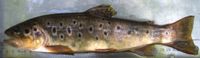
Species description.
Salmo cettii is a highly localized and critically endangered trout species endemic to southeastern Sicily.
Restricted to a handful of short Mediterranean river systems, it represents one of Europe’s most geographically isolated native Salmo species and a key element of Sicily’s freshwater biodiversity.
Adapted to warm, seasonal river environments fed by karstic springs, S. cettii survives in conditions very different from those of most European trout, making it of exceptional scientific and conservation importance.
Taxonomy and Classification.
Salmo cettii belongs to the family Salmonidae and the genus Salmo.
It was originally described in the 19th century and has long been associated with the Mediterranean and North African trout complex, often grouped historically under Salmo macrostigma.
Modern genetic research indicates that Salmo cettii is closely related to North African trout populations, forming part of a southern Mediterranean lineage distinct from Atlantic and Adriatic brown trout.
While taxonomic interpretations vary among authors, S. cettii is widely recognized as a valid endemic species restricted to Sicily.
Physical Characteristics.
The Sicilian trout is a small to medium-sized trout, typically measuring 15–30 cm in length.
It can be distinguished by several characteristic features:
- Persistent parr marks forming a striped pattern along the flanks
- A distinctive pre-opercular spot
- Irregular red and black spotting, usually without pale halos
- Slender body adapted to shallow, fast-flowing streams
Coloration varies with habitat and season, but individuals often display earthy tones that provide camouflage against rocky substrates.
Habitat and Distribution.
Salmo cettii is endemic to a small number of river systems in southeastern Sicily, most notably:
- Alcantara River
- Simeto River
- Anapo River
These rivers are typically short, spring-fed Mediterranean systems characterized by strong seasonal flow variation. The species favors cool, well-oxygenated reaches influenced by groundwater inputs, often occupying shaded sections with gravel and cobble substrates.
Ecology and Life History.
Salmo cettii is a resident and highly site-faithful species, rarely moving far from its home range.
Its diet consists mainly of aquatic insects and other invertebrates, supplemented occasionally by terrestrial prey. Spawning occurs in winter to early spring, with adults selecting shallow gravel beds in spring-fed reaches.
Juveniles develop in protected, low-flow areas where stable temperatures and oxygen levels support early growth.
Conservation Status and Threats.
Salmo cettii is classified as Critically Endangered on the IUCN Red List.
Genetic studies indicate that fewer than 3% of remaining populations are genetically pure, highlighting the severity of its decline.
Major threats include:
- Genetic introgression from stocked non-native trout
- Water abstraction and reduced ecological flows
- Drought and climate-driven habitat loss
- River fragmentation and habitat degradation
Conservation efforts focus on protecting spring habitats, maintaining ecological flows, preventing further stocking, and safeguarding remaining genetically pure populations.
Cultural and Scientific Significance.
The Sicilian trout is one of Europe’s most evolutionarily distinctive trout species, offering valuable insight into Mediterranean freshwater biogeography and post-glacial colonization processes.
Its survival is closely tied to the preservation of Sicily’s last natural river systems.
As such, Salmo cettii serves as both a flagship species for Mediterranean freshwater conservation and a powerful reminder of the vulnerability of island endemics in a changing climate.