Salvelinus alpinus: The Arctic Char.
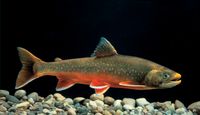
Salvelinus alpinus, known as the Arctic char, is a cold-water salmonid species with a circumpolar distribution across the Northern Hemisphere. It inhabits Arctic and subarctic lakes and rivers from North America through Scandinavia and the British Isles to northern Russia and Siberia. In Europe, it occurs naturally in Iceland, Norway, Sweden, Finland, Scotland, and Ireland, where it thrives in cold, oligotrophic waters. Historically, anadromous populations were also found in Denmark, northern Germany and the Netherlands, where char migrated to the sea and returned to spawn in rivers, though these have long since disappeared.
Taxonomy and Classification.
Belonging to the family Salmonidae and the genus Salvelinus, Salvelinus alpinus was first described by Linnaeus in 1758. It is the widespread circumpolar member of the Arctic–Alpine char complex, a group of closely related char that diversified across the Northern Hemisphere during and after the Ice Ages. Modern genetic research recognizes the Alpine char (Salvelinus umbla) as a distinct southern European species, while the Deepwater char (Salvelinus profundus) and Ammersee char (Salvelinus evasus)are also increasingly supported as a separate species. Many historically described European char, particularly from the British Isles, Iceland, and Scandinavia, are now generally regarded as localized forms of Salvelinus alpinus rather than separate species. These isolated populations evolved after the last Ice Age as Arctic char became trapped in individual lakes and river systems, where they developed unique ecological and morphological adaptations. As research continues, the taxonomy of European char remains an active field of study, but Salvelinus alpinus is widely recognized as one of Europe's principal native char species
Physical Characteristics.
Arctic char display striking variation in color and form depending on habitat and season. Non-spawning individuals are silvery with a bluish sheen, while breeding males develop brilliant orange to red bellies, pale spots, and a pronounced hooked jaw (kype). Body coloration and patterning differ between lake and anadromous populations. Adults typically measure 25–70 cm, but can exceed 80 cm in large northern lakes and fjords.
They are among the most beautiful and variable salmonids in the world.
Habitat and Distribution.
Salvelinus alpinus occupies cold, deep, and well-oxygenated lakes and rivers throughout the Arctic and subarctic regions. In Europe, it is native to Iceland, Scandinavia, northern Britain, and Ireland, and historically extended southward through glacial connections to northern Germany and the Low Countries. Formerly anadromous populations in rivers such as the Ems, Weser, and Elbe migrated between the sea and freshwater but became extinct by the late 19th century due to warming, pollution, and damming.
In the Alpine region, the char found in deep lakes (e.g., Constance, Geneva, Garda, Maggiore) are now recognized as a separate species, Salvelinus umbla.
Ecology and Life History.
Spawning occurs in autumn and early winter on gravel or rocky substrates, often in nearshore areas or spring-fed inlets. Eggs incubate through the winter and hatch in early spring. Juveniles occupy shallow zones before moving to deeper, colder waters. The Arctic char is an opportunistic feeder, consuming zooplankton, aquatic invertebrates, and small fish, and exhibits resource polymorphism, different feeding and morphological forms within a single lake. Anadromous populations migrate to the sea after several years in freshwater, returning to spawn much like salmon.
Conservation Status and Threats.
Although widespread, S. alpinus faces regional declines due to environmental pressures.
Key threats include:
- Climate change, reducing cold-water habitat and altering lake stratification
- Eutrophication, leading to oxygen depletion in deep lakes
- Competition and hybridization with introduced salmonids
- Overfishing and loss of anadromous migration routes
The species remains abundant in northern Europe but is threatened or extinct in its southernmost habitats.
In Scotland and Ireland many populations are now protected or managed as part of conservation programs for cold-water lake ecosystems.
Cultural and Scientific Significance.
The Arctic char is one of the world’s most northerly freshwater fish and a symbol of pristine, cold-water environments. It has long held cultural importance as a traditional food source in northern Europe and as a prized sport fish. For scientists, S. alpinus is an exceptional model for studying adaptation, polymorphism, and postglacial colonization, showing how one species can evolve diverse forms across different climates and habitats. Its sensitivity to warming makes it a key indicator species for the impacts of climate change on freshwater ecosystems.