Hucho hucho: The Danube Salmon.
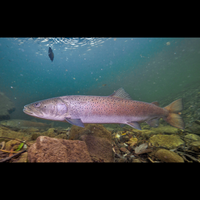
Hucho hucho, commonly known as the huchen or Danube salmon, is one of Europe’s most iconic and endangered freshwater fish. Endemic to the Danube River basin, this large predatory salmonid plays a crucial ecological role in the rivers it inhabits and serves as an indicator of pristine riverine environments. Because of its size, rarity, and ecological significance, it is often regarded as one of the most important freshwater fish species in Europe.
Taxonomy and Classification.
Hucho hucho belongs to the family Salmonidae and is the type species of the genus Hucho, which includes several large river salmonids. Described by Linnaeus in 1758, it is evolutionarily distinct from salmon and trout of the genus Salmo and adapted specifically to large, cold, fast-flowing rivers. Although no formal subspecies are currently recognized, genetic studies show significant regional structuring within the Danube basin due to the fragmented state of modern populations. It is one of only a few Hucho species worldwide, making it of major conservation and evolutionary importance.
Physical Characteristics.
The huchen is among the largest freshwater salmonids in the world.
Typical adults measure 80–120 cm, with exceptional individuals reaching 150 cm and 50+ kg.
Key characteristics include:
- Long, torpedo-shaped body built for fast currents.
- Large head and strong jaws lined with sharp teeth.
- Reddish-bronze to copper coloration with small, dark spotting.
- Slightly forked caudal fin, enabling powerful swimming bursts.
Juveniles are slender with lighter coloration, while mature adults develop thicker bodies and more pronounced musculature.
Habitat and Distribution.
Hucho hucho is endemic to the Danube River system. Historically, its range extended from southern Germany and Austria downstream through Hungary, Slovakia, and the Balkans. Today its remaining strongholds are fragmented and occur mainly in the Western Balkans, including:
- Slovenia.
- Bosnia and Herzegovina.
- Montenegro.
- Serbia.
It prefers:
- Cold, fast-flowing rivers.
- High oxygen content.
- Deep pools for shelter.
- Clean gravel substrates for spawning
Because it requires large, connected river systems, the huchen is exceptionally vulnerable to habitat fragmentation.

.jpg/picture-200?_=1912de5ab40)
.jpg/picture-200?_=1912de5a758)
Ecology and Life History.
Huchen are apex predators, feeding primarily on:
- Grayling (Thymallus thymallus).
- Trout.
- Minnows and other small fish.
- Occasionally crustaceans and aquatic insects.
Spawning occurs in spring, when adults migrate into suitable tributaries. Females dig redds in clean gravel where they deposit thousands of eggs, which hatch after several weeks. Juvenile huchen remain in shallow, calmer areas before dispersing into larger rivers. The species is mostly non-migratory, though adults may travel long distances to access spawning grounds or seasonal feeding areas.
Conservation Status and Threats.
Hucho hucho is listed as Endangered on the IUCN Red List.
Its populations have declined sharply due to:
- Hydropower and river regulation — blocking migrations and destroying key habitats.
- Pollution and sedimentation — degrading spawning grounds.
- Overfishing — particularly where enforcement is weak.
- Climate change — reducing cold-water habitats and altering flow regimes.
In the Balkans alone, proposed hydropower projects threaten over 90% of remaining suitable habitat, making the region the global conservation priority for the species. Conservation measures include protected river stretches, hatchery-supported reintroduction programs, and international initiatives that highlight the Danube basin as a biodiversity hotspot.
Cultural and Scientific Significance.
The huchen has a long and respected place in Central European angling culture and is often described as “the fish of a thousand casts”, a reflection of both its rarity and the immense challenge of catching one. Its elusive nature has made it a legendary species among fly fishers and a symbol of perseverance and respect for wild rivers. To science, it is valuable because of:
- its evolutionary distinctiveness.
- its sensitivity to habitat change.
- its role as a bioindicator of river health.
Protecting Hucho hucho is not only about saving a species, it preserves the integrity of the Danube’s last wild river systems.