The Danubian Urforelle – Protecting a Native Lineage.
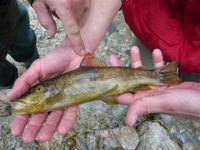
The Urforelle is the native Danubian lineage of the Brown Trout (Salmo trutta)—a unique evolutionary line that has developed over thousands of years in the alpine tributaries of the Danube River Basin.
These trout are perfectly adapted to:
- cold, fast-flowing mountain streams.
- extreme seasonal snowmelt.
- sudden flood events.
- variable temperatures and hydrological conditions.
Compared to the commonly stocked Atlantic lineage, Danubian trout show higher survival rates, stronger predator awareness, and a more agile flight response. Despite their natural advantages, decades of widespread stocking with the cheaper, easily available Atlantic strain has pushed the native lineage to the brink of extinction. Today, only three genetically distinct Danubian populations remain:
- Gailtal-type.
- Gurktal-type.
- Karawanks-type.
The Urforelle project aims to preserve, restore, and reintroduce these native trout across their historical range.
Origins of the Project.
The restoration effort began in 1998, when Dr. Nikolaus Medgyesy and Dr. Steven Weiss launched a study to locate and preserve remnants of the Danubian strain.
One of the most important discoveries was the population in Gossenköllesee (2,417 m)—likely originating from a medieval stocking and genetically isolated for centuries.
At that time, only three Austrian locations still held Danubian populations, all critically endangered. Dr. Medgyesy’s vision was clear:
- safeguard the remaining trout.
- understand their genetics.
- breed them responsibly.
- reintroduce them into suitable rivers within their native catchment.
With support from the University of Innsbruck, the first controlled breeding attempts began in the university’s zoological facilities.
The Tiroler Fischereiverband Takes Over.
In 2010, the Tiroler Fischereiverband (TFV) approached Dr. Medgyesy to develop a large-scale conservation and reintroduction program. To make this possible, the TFV leased the Thaur fish farm and appointed Nikolaus Medgyesy Jr. as manager. The early years required enormous effort:
- capturing potential brood fish.
- individual marking.
- collecting tissue samples.
- pairing fish based on genetic results.
Only a small number of pure Danubian trout were produced in the first year.
From year three onward, production increased to 50,000 juveniles annually, later reaching 120,000–180,000 fish per year. Today, all managed waters of Tirol receive stockings of Danubian trout, making this one of the most important native trout restoration programs in Europe.
Other Urforelle Initiatives.
The Danubian lineage restoration is not limited to Tirol:
- Naturschutzbund Kärnten breeds and releases Danubian trout in Carinthia.
- Hohe Tauern National Park stocks Danubian-type fish in suitable waters in Salzburg.
Together, these projects help rebuild genetically pure Danubian populations throughout Austria.
Conservation Challenges.
Despite progress, the Danubian lineage is still under threat:
- Some waters continue to receive Atlantic lineage trout due to their lower cost and larger availability.
- Native Danubian fry are typically stocked at smaller sizes, which increases cost and reduces short-term angling appeal.
- Fragmented habitats and altered rivers limit natural reproduction.
Maintaining and expanding genetically pure Danubian populations requires long-term commitment and continuous stocking with verified native broodstock.
Our goal.
At the European Native Trout Challenge, we aim to support and promote the restoration of the Danubian lineage.
By assisting projects such as the TFV’s Urforelle program, we hope to:
- reduce the cost gap between Danubian and Atlantic lineage stocking.
- encourage more river managers to choose native trout.
- expand restoration efforts to other parts of the Danube Basin, including suitable alpine waters in Slovenia, Italy and beyond.
- The return of the Urforelle is one of the most important native trout conservation stories in Europe—and with continued support, it can become a true success.
For more insight into this work, the documentary “Die Rückkehr der Urforelle” offers a detailed look into the project and the people behind it.