Salmo ferox: The Ferox Trout.
.jpg/picture-200?_=1a03888bee8)
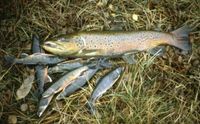
Salmo ferox, commonly known as the Ferox trout, is one of Europe's most remarkable freshwater predators. Unlike most brown trout, Ferox trout are long-lived, exceptionally fast-growing, and become highly piscivorous, feeding primarily on other fish. Although its taxonomic status remains debated, many researchers consider Ferox trout to represent a distinct evolutionary lineage deserving of separate conservation.
Taxonomy and Classification.
Salmo ferox belongs to the family Salmonidae and the genus Salmo. Its taxonomic status has been debated for more than a century. Some authorities recognize Salmo ferox as a distinct species, while others consider it a specialized form or ecotype of the brown trout (Salmo trutta). Recent genetic studies have added an interesting dimension to this debate. In several lakes, Ferox trout have been shown to be more closely related to Ferox populations in other lakes than to the brown trout living alongside them. They also display distinct life-history characteristics, including different feeding strategies, growth rates, age at maturity, and spawning behavior. In many lakes, Ferox trout appear to breed almost exclusively with other Ferox trout, maintaining a degree of reproductive isolation despite sharing the same waters as brown trout. Whether future research ultimately confirms S. ferox as a full species, a subspecies, or a highly specialized ecotype, its unique evolutionary history and small isolated populations make it an important conservation unit deserving of protection.
Physical Characteristics.
The Ferox trout is built for a predatory lifestyle in large, deep lakes. Key characteristics include:
- Large, elongated and powerful body
- Silver to bronze coloration with relatively few dark spots
- Large head and powerful jaw
- Thick caudal peduncle and broad tail for powerful swimming
- Slow maturation but exceptional longevity
Adults commonly reach 50–80 cm, while exceptional specimens exceed 100 cm and may weigh over 15 kg, making them among Europe's largest native trout.
Habitat and Distribution.
Salmo ferox occurs only in a limited number of large, deep, oligotrophic lakes in northwestern Europe. Known populations occur in:
- Scotland
- Ireland
- Parts of England
- Wales
Ferox trout typically inhabit:
- Deep, cold, oxygen-rich lakes
- Open-water (pelagic) zones
- Areas supporting abundant prey fish such as Arctic charr, whitefish, or perch
Unlike many brown trout populations, Ferox spend much of their adult lives hunting in open water rather than remaining close to the shoreline.
Ecology and Life History.
The Ferox trout follows a unique life-history strategy compared to typical brown trout. Key traits include:
- Juveniles initially feed on aquatic insects and invertebrates
- Adults shift to an almost exclusively piscivorous die
- Extremely rapid growth after switching to fish prey
- Late sexual maturity, often at 5–8 years of age
- Exceptional longevity, with individuals living more than 20 years
The transition to a fish-based diet allows Ferox trout to achieve sizes rarely seen in ordinary brown trout populations. Their slow maturation means populations recover only slowly from overfishing.
Conservation Status and Threats.
Salmo ferox has not been universally assessed as a separate species, largely because of the ongoing taxonomic debate. Nevertheless, many Ferox populations are considered vulnerable due to their rarity and unique genetics. Main threats include:
- Overfishing of large breeding adults
- Illegal harvest
- Habitat degradation
- Declines in prey fish populations
- Climate change affecting cold-water lake ecosystems
Most known Ferox populations consist of relatively few breeding individuals. Even if future taxonomic work concludes they represent a specialized form of brown trout rather than a distinct species, conserving these populations remains essential because they represent unique genetic lineages and highly specialized ecological adaptations. Many fisheries now encourage or require the catch-and-release of large Ferox trout to help protect these exceptional fish.
Cultural and Scientific Significance.
The Ferox trout has long fascinated anglers and biologists alike. It is regarded as one of Europe's most challenging freshwater game fish due to its rarity, intelligence, and immense size. In Scotland and Ireland especially, Ferox trout have achieved an almost legendary status among specialist anglers. Scientifically, Salmo ferox is important as:
- An example of extreme ecological specialization within the brown trout complex
- A model for studying predator evolution in freshwater ecosystems
- Evidence of long-term reproductive isolation despite living alongside closely related trout
- A valuable conservation unit with unique genetic diversity
Whether ultimately recognized as a full species or not, the Ferox trout represents one of Europe's most distinctive native salmonids and highlights how unique evolutionary lineages can develop within isolated lake ecosystems.