Salmo peristericus: The Prespa Trout.
.jpg/picture-200?_=1a038898a08)
.jpg/picture-200?_=1a03889ad30)
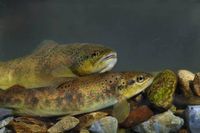
Salmo peristericus, commonly known as the Prespa trout, is a rare and endemic salmonid species confined to the Lake Prespa basin in the Balkans. Shared between North Macedonia, Greece, and Albania, the Prespa watershed is home to one of Europe's most localized native trout species. Once inhabiting both the lake and its tributary streams, the Prespa trout is now largely restricted to a handful of spawning rivers, making it one of the region's most threatened freshwater fish.
Taxonomy and Classification.
Salmo peristericus belongs to the family Salmonidae and the genus Salmo. The Prespa trout is recognized as a distinct species within the diverse assemblage of Balkan trout. The Balkan Peninsula is considered one of the world's hotspots for trout diversity, where mountain ranges and isolated river systems have driven the evolution of numerous endemic species. Originally described from the tributaries flowing into Lake Prespa, Salmo peristericus is genetically distinct from neighboring trout species, although ongoing genetic research continues to refine the relationships among Balkan Salmo. Despite these taxonomic discussions, the Prespa trout is widely accepted as a valid species due to its long isolation and unique evolutionary history.
Physical Characteristics.
The Prespa trout is well adapted to life in cool, clear mountain streams and historically to the open waters of Lake Prespa. Key characteristics include:
- Olive-brown to silvery coloration
- Numerous black spots across the body
- Distinct red spots, often surrounded by pale halos
- Streamlined body suited for flowing water
- Strong fins adapted for migration between rivers and the lake
Adults typically reach 25–50 cm, although larger individuals were historically reported when the lake population was more abundant.
Habitat and Distribution.
Salmo peristericus is endemic to the Lake Prespa watershed, which is shared between North Macedonia, Greece, Albania. Historically, the species spent much of its life feeding within Lake Prespa before migrating into tributary rivers to spawn. Today, naturally reproducing populations survive primarily in four tributary streams:
- Brajčinska River
- Kranska River
- Leva Reka
- Golema Reka
These rivers provide the cold, clean, well-oxygenated water and gravel spawning habitat essential for the species' survival.
Ecology and Life History.
The Prespa trout has evolved as a migratory lake trout closely linked to both Lake Prespa and its tributaries.
Key traits include:
- Feeding primarily on aquatic insects, crustaceans, and small fish
- Juveniles developing in tributary streams
- Historically migrating between Lake Prespa and spawning rivers
- Spawning during late autumn and winter
- Strong fidelity to traditional spawning streams
Unfortunately, river modifications and barriers have disrupted these natural migrations in many locations, forcing some populations to complete their life cycle entirely within the rivers.
Conservation Status and Threats.
Salmo peristericus is currently classified as Critically Endangered due to its extremely restricted distribution and continuing population decline. Main threats include:
- River regulation and barriers preventing spawning migrations
- Water abstraction reducing stream flows
- Habitat degradation and pollution
- Illegal fishing, particularly during spawning migrations
- Climate change affecting cold-water habitats
- Genetic introgression from stocked non-native trout
The species now survives in only a few isolated spawning streams, making each remaining population critically important for its long-term survival. Conservation efforts focus on restoring river connectivity, protecting spawning habitats, preventing further introductions of non-native trout, and coordinating conservation measures between North Macedonia, Greece, and Albania.
Cultural and Scientific Significance.
The Prespa trout is one of the flagship freshwater species of the Prespa Lakes, an internationally recognized region of exceptional biodiversity. As one of the Balkans' endemic trout species, it illustrates how long-term isolation within ancient lake basins has driven the evolution of unique salmonid lineages. The species also serves as an important indicator of healthy mountain stream ecosystems and highlights the ecological connection between lakes and their tributaries. Scientifically, Salmo peristericus is important as:
- An endemic species unique to the Lake Prespa basin
- A model for studying trout evolution in isolated lake systems
- An indicator of ecological connectivity between lakes and rivers
- A conservation priority due to its extremely limited distribution and unique genetic heritage
The future of Salmo peristericus depends on protecting both the remaining spawning rivers and the wider Lake Prespa ecosystem. Preserving this species also safeguards one of Europe's most distinctive and vulnerable freshwater evolutionary lineages.